

This article is for informational purposes only and is not legal advice.
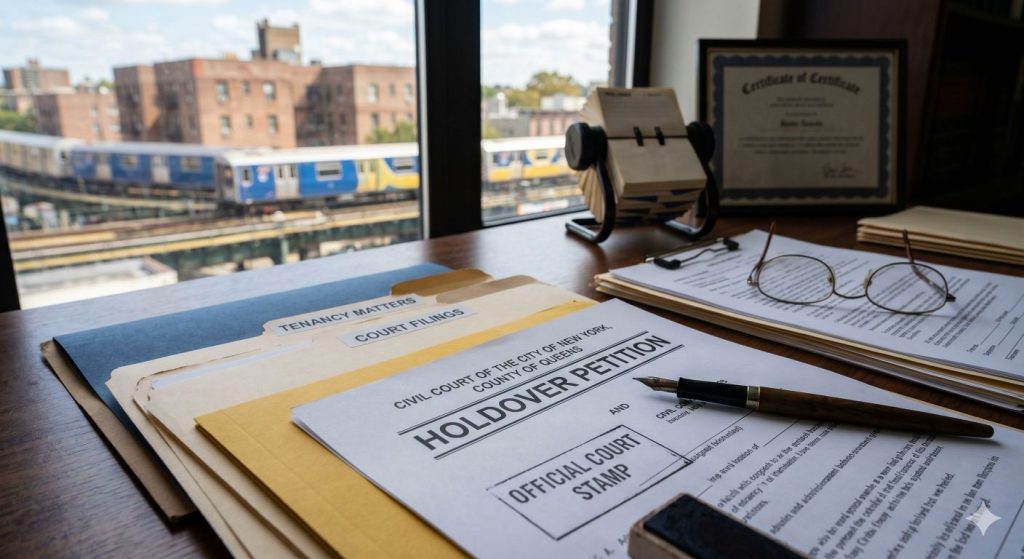
If you’re a New York City landlord trying to remove a tenant for reasons other than unpaid rent, you’re likely dealing with what Housing Court calls a holdover case. These cases can be confusing, highly technical, and easy to mess up if you don’t follow the rules exactly.
This guide breaks down the official NYC Housing Court process in simple, landlord‑friendly language so you understand what a holdover case is, when it applies, and how to start one correctly.
What Is a Holdover Case?
A holdover case is a legal action filed in NYC Housing Court when a landlord wants someone to leave an apartment without claiming they owe rent.
Common reasons include:
- The lease expired and the tenant won’t move out
- A tenant violated the lease (unauthorized occupants, pets, or illegal use)
- Someone is living in the unit without a legal right to be there (licensee or squatter)
- A tenant is creating a nuisance or disturbing other residents
If the issue is unpaid rent, that’s a nonpayment case, not a holdover.
Sign Up for our Newsletters
A monthly roundup of legislation, articles, and resources specifically related to Queens Homeowners and Homebuyers.
Step 1: Serving the Correct Notice (This Is Critical)
Most holdover cases require a written notice before you can file anything in court. This is one of the most common places landlords make mistakes.
There are many notices that are required by law to be served on the tenant prior to the commencement of a holdover proceeding, depending on the nature of the tenancy and the grounds upon which the proceeding is brought. They include Notices to Quit, Notices to Cure a Substantial Violation of the Lease, Notices of Termination or Notices of Intent Not To Renew a Lease. Here is a brief explanation of each tenancy/situation:
1. Notice of Intent Not to Renew
This is the most common notice for tenants with a fixed-term lease. It is used when the landlord simply wants the relationship to end naturally on the lease’s expiration date.
- When it’s sent: At least 30, 60, or 90 days before your lease expires (depending on how long you’ve lived there).
- The Goal: To prevent the lease from renewing. It tells the tenant, “When this lease ends on [Date], I am not offering you a new one. You must be out by then.”
- Good Cause Note: Since 2024, if your apartment is covered by Good Cause Eviction laws, the landlord can no longer just say “no” for any reason; they must list a legal justification (like wanting the unit for themselves or documented lease violations) even if the lease is ending.
2. Notice of Termination
This is typically used for month-to-month tenants or to end a tenancy immediately following a failed “Notice to Cure.”
- When it’s sent: Any time, provided the landlord gives the required 30/60/90 days’ notice.
- The Goal: To officially end the legal right to live there. For month-to-month tenants, this is the document that kills the “handshake” agreement.
- The Distinction: Unlike a non-renewal (which waits for a lease to end), this notice “terminates” the tenancy on a specific date chosen by the landlord.
3. Notice to Quit
This is the most “aggressive” of the three. It is often the final warning before a landlord files a “Holdover” case in Housing Court.
- When it’s sent: Usually after a lease has already expired or after a Notice of Termination has passed, and the tenant is still in the apartment.
- The Goal: It is a legal prerequisite for a lawsuit. It tells the tenant: “Your legal right to be here has ended. If you are not out in [X] days, I am taking you to court.”
- Special Case: A “14-Day Notice to Pay or Quit” is specific to non-payment of rent. It says you have 14 days to pay everything you owe or leave, otherwise, an eviction case will begin.
Comparison Summary
| Feature | Notice of Non-Renewal | Notice of Termination | Notice to Quit |
| Used For | Ending a fixed-term lease. | Ending a month-to-month setup. | The final step before a court case. |
| Timing | Before the lease ends. | Any time (with proper notice). | After a deadline has passed. |
| Good Cause? | Required for most units. | Required for most units. | Usually refers back to the original cause. |
| Key Message | “We aren’t signing again.” | “Your tenancy is ending now.” | “Leave or see you in court.” |
Notice to Cure a Substantial Violation of the Lease
A Notice to Cure a Substantial Violation of the Lease in NYC is a formal, written document from a landlord notifying a tenant of a lease violation and giving them typically 10 days to correct (or “cure”) the issue before an eviction proceeding (holdover case) begins. If the violation is not fixed within this time, the landlord can serve a Notice of Termination. In the eyes of NYC housing law, it is a mandatory first step a landlord must take before they can try to terminate a lease for behavioral reasons.
The violation must be substantial—meaning it breaches a significant obligation in your lease agreement. Common examples include:
- Unauthorized Subletting: Renting out the unit on Airbnb or having a roommate not listed on the lease (without following legal procedures).
- Unauthorized Pets: Keeping a dog in a “no-pets” building.
- Operating a Business: Using a residential apartment as a commercial office or storefront.
- Alterations: Making major renovations or structural changes without the landlord’s written consent.
Important: If the notice is wrong or improperly served, your case can be dismissed — even if you’re otherwise right.
Free Home Valuation
Request a free home valuation from one of our local Queens real estate experts.
Step 2: Starting the Case in Housing Court
Once the notice period expires and the person hasn’t left, you can officially start the holdover case.
Here’s how it works:
- Prepare the court papers (Petition and Notice of Petition)
- Buy an index number from the Housing Court clerk (this officially opens the case)
- Receive a court date, time, and courtroom
- Serve the tenant with the court papers within the legally required timeframe
- File proof of service with the court
The case must be filed in the Housing Court for the borough where the property is located.
You must purchase the appropriate predicate notice form and serve it on the tenant in the manner required by law. Different rules for when and how to serve the predicate notices apply in different cases. For example, a 30-day notice must be served on the tenant before the beginning of the next “rental term.” A rental term is the time beginning the day the tenant is supposed to pay the rent and ending the day before the next rental payment is due.
Predicate Notice Forms by Scenario
| Scenario | Primary Form Used | Timeframe |
| Owe Back Rent | 14-Day Notice to Pay or Quit (Rent Demand) | 14 Days |
| Breaking Lease Rules | Notice to Cure (must precede a termination) | 10 Days |
| Fixed Lease Expiring | Notice of Intent Not to Renew | 30/60/90 Days* |
| Month-to-Month | Notice of Termination | 30/60/90 Days* |
| Illegal Occupant | 10-Day Notice to Quit (Squatters/Licensees) | 10 Days |
Step 3: Serving the Tenant Properly
Service rules are strict. In most cases:
- Papers must be served 5–12 days before the court date
- Service must be done by someone not involved in the case
- If “nail and mail” service is used, the court must also mail copies
Missing a step here can delay your case for weeks or months.
Required Manner of Service
In NYC, “service” is governed strictly by RPAPL § 735. A landlord cannot simply hand the paper themselves; it must be delivered by a non-party (usually a professional process server) in one of three ways:
A. Personal Delivery
The server hands the papers directly to the tenant. This is the “gold standard” and is complete immediately.
B. Substituted Service
If the tenant isn’t home, the server can leave the papers with a person of “suitable age and discretion” (usually 18+) who lives or works at the property.
- The “Plus” Rule: Within one day of leaving the papers, the landlord must also mail two copies to the tenant: one via Certified Mail and one via First Class Mail.
C. Conspicuous Place Service (“Nail and Mail”)
This is only allowed after at least two “due diligent” attempts to serve the tenant personally or via substituted service.
- The “Nail”: The notice is taped to the door or slid under it.
- The “Mail”: Within one day, two copies must be mailed (one Certified, one First Class).
What Happens on the Court Date?
Your first appearance is usually in the Resolution Part, where:
- A judge or court attorney reviews the case
- Both sides may be encouraged to settle
- Payment plans, move‑out dates, or agreements may be discussed
If no agreement is reached, the case may be scheduled for trial.
Bring all documentation, including:
- Lease and renewal history
- Copies of notices
- Proof of service
- Photos, letters, or complaints (if applicable)
Why Holdover Cases Are More Complicated Than Nonpayment Cases
Holdover cases require landlords to prove legal grounds for removal, not just unpaid rent. Depending on the situation:
- Different notices may apply
- Some cases don’t require notices at all
- Tenant defenses can be complex
- Technical errors can restart the process
Because of this, many landlords choose to work with a housing attorney or court help center. If you need a recommendation to a good tenant landlord attorney, let us know and we can send you a few names.
Frequently Asked Questions (FAQs)
Can I file a holdover case without a lawyer?
Yes, but it’s risky. The court strongly encourages landlords to get legal help because procedural mistakes are common.
How long does a holdover case take?
It varies widely. Some cases resolve in a few months, others take years, especially if there are adjournments or trials.
What if the tenant fixes the problem after I serve a Notice to Cure?
If the issue is properly cured within the allowed time, you may not be able to proceed with eviction.
Can I collect rent during a holdover case?
Sometimes — but accepting rent improperly can create defenses for the tenant. Always consult an attorney before accepting payments.
Is a holdover the same as an eviction?
A holdover case is the legal process that can lead to an eviction. Only a marshal can legally remove someone after a court order.
Common Landlord Tips to Avoid Costly Mistakes
- Use the correct notice for your specific situation
- Follow service rules exactly — no shortcuts
- Keep written records of all issues
- Don’t accept rent without legal advice
- File in the correct borough court
- When in doubt, consult a housing attorney
Final Thoughts
Holdover cases are one of the most technical areas of NYC Housing Court. While the process is designed to be accessible, even small errors can delay your case or force you to start over.
If you’re a landlord dealing with an expired lease, unauthorized occupants, or serious lease violations, understanding the holdover process is the first step toward protecting your property, and your time.
Need Help? Contact Us.
This article is for informational purposes only and is not legal advice.
